-
tel: +86 13851019143
-
email: jade1971@163.com
-
WechatApp: Jade(+8613851019143)

Some applications of steel shot in shot blasting process
Some applications of steel shot in shot blasting process
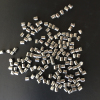 10 Feb
Regarding some applications of steel shot in the shot blasting process, if we need to achieve uniform roughness, we are required to follow the following points when selecting steel shot: 1. The particle size of steel shot needs to be uniform, and spherical steel shot requires diameter The size is uniform, the angular sand (ie casting steel sand) requires the basic shape of the particles to be the same, and the steel wire shot requires a diameter and length ratio of about 1:1. 2. The initial hardness of the steel shot must be greater than the initial hardness of the workpiece to be cleaned, generally exceeding the hardness of HRC5~HRC10, in order to obtain a certain roughness; if the initial hardness of the steel shot is less than or equal to the initial hardness of the workpiece to be cleaned, it will not reach a certain degree of roughness. to the request. 3. The roughness of the workpiece surface is determined by the diameter of the steel shot. The larger the diameter of the steel shot, the greater the peak-to-valley drop on the surface of the hit workpiece, that is, the greater the roughness; on the contrary, less roughness. 4. Spherical steel shot (including cast steel shot and steel wire cut shot, rounded shot) and angular steel shot (including angular sand and steel wire cut shot), the roughness of spherical steel shot on the surface of the hit workpiece is smaller than that of angular steel shot This is because the angular steel shot has certain edges and corners, which can cause the end with the edge to generate a deep valley on the surface of the workpiece through cutting impact; while the spherical steel shot is spherical because the surface is formed on the surface of the hit workpiece. The valley will be smaller than the angular steel shot. 5. The use of steel wire cut shot, because there are many ordinary steel wire cut shots on the market with a length of 3mm, or even 4~5mm, like a rod, this steel shot will have a certain impact on the shot blasting effect, which is embodied in the following A few points: 1) When the rod-shaped steel shot is shot blasting, if the head hits the workpiece, it can only play the role of cutting shot, and when the head is rounded, it can only play the role of round shot.
2) If the rod hits the workpiece horizontally, it will only cause the rod to wear and tear in the length direction, and it will not produce roughness on the key surface, which will not play the role of shot blasting, but will cause consumption and affect the shot blasting effect. 3) During the shot blasting process, the amount of steel shot flowing into the shot blasting machine is certain. When the cut shot is too long and the fluidity is not good, more steel shot will be blocked from flowing down, thereby reducing the amount of steel shot required per unit area. It reduces the shot blasting efficiency, affects the shot blasting speed of the workpiece, and affects the shot blasting effect. 6. When the cast steel shot or cast steel sand is broken, the roughness of the workpiece surface after shot blasting is not uniform. This situation is good or bad. After adding new cast steel shot or cast steel sand, The roughness will be a little better, and when added and used for a period of time, the roughness will change a lot. 7. Because cast steel shot or cast steel sand is easily broken, it increases the cost of consumables for the user, generates a lot of dust, and shortens the life of wearing parts. Many companies have begun to use more environmentally friendly and durable reinforced steel shot, such as Steel mills, shipyards, auto parts, medical equipment, aviation, etc. 8. Why do we recommend the use of strengthened steel shot? (see attachment on next page)
Attachment: Why is it recommended to use strengthened steel shot 1. Why is it recommended to use strengthened steel shot? (1) Characteristics of cast steel shot (cast steel sand): 1) Since the cast steel shot (cast steel sand) is made of casting, the cast steel shot (cast steel sand) will be hollow due to the generation of pores during the casting process, and the cast steel shot (cast steel sand) will be hollow. Steel shot (cast steel sand) is highly brittle, these two points determine that cast steel shot (cast steel sand) is easily broken due to impact during high-speed projection, resulting in fast consumption and high cost; 2) Cast steel shot (cast steel sand) After crushing, a large amount of dust will be generated, which will generate a lot of pressure on the filter element in the dust collector, which will easily lead to serious dust accumulation in the filter element and accelerate the damage of the filter element; 3) The wearing parts in the shot blasting machine are made of high-chromium and high-manganese materials, which are resistant to Impact, but it is not resistant to flat flow wear. When the amount of dust in the shot blasting machine is large, the dust collector cannot filter in time. At this time, a lot of dust will enter the shot blasting machine with the shot circulation system, because the steel shot is a large mass object. It is ejected by the shot blasting machine, and the dust is light and cannot be completely ejected like a steel shot, and a part of it flows and rubs on the surface of the shot blasting blade, which accelerates the damage of the wearing parts (just like quicksand scouring stones). 4) When the amount of dust is large, it will have a certain impact on the effect of shot blasting. The reason is that part of the dust is thrown onto the workpiece, and the flow of steel shot is controlled by an ammeter, and the flow value is relatively fixed. The more dust there is, the less steel shot will be, and the projectile effect will be unsatisfactory. Therefore, the surface of the workpiece after shot blasting with strengthened steel shot is clean, while the surface of the workpiece after shot blasting with cast steel shot (cast steel sand) will be stained with floating dust.

(2) Characteristics of reinforced steel shot: 1) The reinforced steel shot is rolled, has no hollow, high density, and strong toughness. It is not easy to be broken during high-speed projection. Only the surface is worn like peeling egg shells, and it can continue to be recycled. The consumption is slow and the cost is relatively low; 2) Since the reinforced steel shot is not easy to break, it is much smaller than the dust generated by the cast steel shot (cast steel sand), and the filter pressure of the filter element in the dust collector is lower than that of the cast steel shot (cast steel sand), which can be Extend the life of the filter element; 3) Since the dust generated by the reinforced steel shot is small, the instantaneously generated dust is filtered in time, and little dust continues to circulate in the shot circulation system, which prolongs the life of the wearing parts in the shot blasting machine; 4 ) According to practical experience, the service life of reinforced steel shot is more than 3 times that of cast steel shot (cast steel sand). 2. Introduce the comparative test of strengthening steel shot and cast steel shot. How to prove that the life of the strengthened steel shot is 3 times that of the ordinary cast steel shot, we usually say that the service life of the strengthened steel shot is three times that of the ordinary cast steel shot, which means that it has passed the Owen test under certain conditions. The Owen test is also known as the 100% substitution test. The steel shot is taken out and weighed in a cycle of 500 cycles and the loss rate of each cycle is calculated according to the formula. When all the loss values reach 100 grams, the Owen life of the steel shot is calculated according to the formula. . Taking ordinary cast steel shot (S330, strengthened steel shot 1.0mm (G1) HV400-500 as an example, the loss rate of cast steel shot after 500 cycles is 27.83%, and the loss rate of strengthened steel shot is 6.6%; the average loss of cast steel shot The average loss rate of reinforced steel shot is 23.05%, and the average loss rate of reinforced steel shot is 9.188%. During the simulated shot blasting process, the surface layer of reinforced steel shot manufactured by a special process is like peeling egg shells, the smaller it is, the smaller it will not be directly broken, and the loss rate is very high from beginning to end. The reason is that their processing technology determines the difference in their physical properties: strengthened steel shot is drawn and strengthened through steel wire and other similar forging processes, while cast steel shot is obtained through casting process, so The internal molecular structure and density of the two are very different; the Owen test is an important means to detect the cyclic service life of steel shot, but in actual production, due to the different equipment performance and operation process of each factory, the service life will be different. Difference. The key is that the service life of the two types of steel shot is different. The key is that their failure methods are very different: the strengthened steel shot fails in the way of wear, while the cast steel shot fails in the way of breaking. We mentioned above. The results obtained in the Owen test are that the service life of the reinforced steel shot is three times or more than that of the cast steel shot. The characteristics of the cast steel determine its unique advantages in shot peening: 1: Shot peening (blasting) strengthening During the strengthening process, due to the crushing failure mode of the cast steel shot (the steel shot becomes smaller and has edges and corners after crushing) As a result, the strength of shot blasting (blasting) is quickly reduced, and all the broken steel shot must be screened out to ensure stable strength and reduce the damage of the workpiece due to the edges and corners of the steel shot; in this process, the steel is strengthened. The service life of the shot is actually three times longer than that of the cast steel shot. 2: Shot blasting (blasting) cleaning In the process of cleaning, it is also due to the crushing failure mode of the cast steel shot (the steel shot becomes smaller and has edges and corners after being broken). ) leads to a rapid reduction in the strength of shot blasting (blasting), which leads to a reduction in cleaning efficiency (the shot blasting treatment time is greatly prolonged). As a result, the roughness is unstable, high and low, and the dust index exceeds the standard. To achieve the same effect as the strengthened steel shot, the amount of the cast steel shot is far greater than three times.

Contact US
Product Information
Quantity
Unit
Piece
Support order samples, customization, wholesale direct, and complete payment. If the product you look for does not have corresponding customized content, pls fill out the form below to contact us, and we will reply ASAP.